Alumni Spotlight on Hannah Richardson ('02)
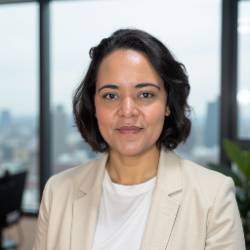 Happy new year, readers! We are SO excited to start out the year shining a spotlight
on one of our rockstar alumni. Hannah Richardson graduated from Loyola in 2002, and
has since been busy founding and growing her company, Montessori Makers Group. Their work includes consultation, individualized leadership coaching, and recruitment
for Montessori schools. She has dedicated her career to supporting schools, teachers,
leaders and families through "building Montessori ecosystems."
Happy new year, readers! We are SO excited to start out the year shining a spotlight
on one of our rockstar alumni. Hannah Richardson graduated from Loyola in 2002, and
has since been busy founding and growing her company, Montessori Makers Group. Their work includes consultation, individualized leadership coaching, and recruitment
for Montessori schools. She has dedicated her career to supporting schools, teachers,
leaders and families through "building Montessori ecosystems."
1. Briefly share your Montessori story. Where did you begin your journey, and how did you arrive at your current role and work?
I stumbled into Montessori when I was barely an adult myself, and it ended up shaping every corner of my life. I came to training straight out of undergrad after a conversation with a professor revealed that there was a different way to think about education outside of the traditional model I had always known. I was sold immediately on the idea and enrolled in Primary training at the Washington Montessori Institute. I’ve been a guide, a coordinator, a coach, a Head of School, and a systems-level leader across public, charter, and independent Montessori programs that served anywhere from 90 children to nearly 800.
Over the years, I realized my real work wasn’t just running schools — it was helping schools run differently. I saw how often Montessori’s deepest values got lost in the noise of compliance, adult culture, inequitable systems, and outdated structures. So I stepped fully into leadership development, organizational design, and justice-centered Montessori consulting.
Today, through Montessori Makers Group and a constellation of aligned ventures, I support schools, teachers, leaders, and families in bringing Montessori to life with clarity, alignment, and social responsibility. My work is about building the Montessori ecosystem we say we believe in — one that honors children, protects adults, and confronts inequity with courage rather than comfort.
2. Upon graduating from the Master's program, what insights were you able to integrate into your practice? How have these practices evolved over time?
Loyola gave me language and structure for things I had felt intuitively for years. It deepened my understanding of observation, adult preparation, and the cosmic task of the teacher — not as lofty abstractions, but as daily leadership responsibilities.
One of the first things I integrated was a commitment to intentionality. Every choice — staffing, schedules, classroom design, adult culture — communicates a value. When those choices are misaligned, children feel it before anyone else does.
What Loyola added was elevation. The graduate classes took the foundation I built in my Montessori training and expanded it so I could lead confidently in diverse environments. My first position after earning my Master’s was as a Primary guide in a public Montessori magnet school, where those insights mattered immediately. My special education coursework gave me the tools to understand and navigate the broader landscape of services and supports.
And my capstone thesis pushed me to articulate Montessori clearly to the larger education community — a skill I rely on constantly in my work today as I bridge philosophy, practice, and public understanding.
Over time, my practice shifted from “How do I lead a classroom?” to “How do I lead systems that uphold Montessori principles?”
The work stretched from the micro to the macro:
- Observation became data literacy.
- Prepared environment became organizational design.
- Grace and courtesy became culture building.
The throughline hasn’t changed: Montessori is only as strong as the adults stewarding it. And Loyola helped me grow into the kind of leader who can steward not just a classroom, but whole communities of practice.
3. As you developed Montessori Makers, what are some of your proudest moments to date? What need were you addressing when you created this platform, and how has that vision evolved?
Montessori Makers began as a simple idea: educators deserve tools and systems that match the depth of their work. Schools deserve clarity. Leaders deserve support. Children deserve adults who are not drowning.
My proudest moments haven’t been the “big things” — launching courses, publishing decodable books, building a full operations platform — though those matter. The moments that stay with me are when a guide tells me, “I finally understand why this part of my classroom wasn’t working,” or a leader says, “I feel like I can breathe again.”
Montessori Makers was born to solve a gap I saw everywhere: incredible philosophy, inconsistent practice, and almost no infrastructure that reflects Montessori values.
The vision has expanded into building what I’ve always wished existed: a network of tools, training, stories, and systems that make strong Montessori practice inevitable, not heroic.
4. As we continue moving into spaces where online learning and communication have become common practice, can you share insights into how various digital platforms have influenced your career trajectory and transformed the reach of your work?
Digital platforms have completely reshaped my work — not by making it trendy, but by making it accessible.
I’ve designed online courses, launched digital literacy tools, built an app for Montessori schools, and created storytelling platforms that allow me to reach educators across the world. These tools let me scale ideas that once lived in binders, workshops, or one-on-one coaching sessions.
Online spaces have also democratized Montessori knowledge. Families who would never walk into a private school can now access explanations, stories, and strategies in minutes. Leaders can access consulting support without geography being a barrier.
Digital tools aren’t replacing Montessori — they’re amplifying it. When used with integrity, they help us bring clarity, equity, and coherence to a field that has often lacked all three.
5. What advice would you offer to current/future graduate students or emerging Montessori professionals entering the field today?
Hold tight to your “why.” Over the years, I’ve gotten myself into hot water more than once by living out a personal edict that guides everything I do: I do not work for adults. I work in service of the child.
Every classroom child I’ve taught, every adult I’ve coached, every school I’ve led, every organization I now support — my commitment is always the same. I am here to protect children’s potential and to build the conditions where they can become everything we’ve ever hoped humanity could be.
One thing I learned in my earliest training has stayed with me for decades: “We should offer every child the same respect as someone we admire.” I take that seriously. Children carry unbounded possibility, and they deserve adults who act like we believe that.
So here’s my advice:
- Do the big work with a clear heart. This is service work. It’s not glamorous, and it’s not about ego. It’s about stewarding human development with humility and courage.
- Learn the philosophy deeply — then live it boldly. Montessori was a radical. If you’re not willing to examine systems, confront inequity, and challenge outdated norms, you’re not doing the philosophy justice.
- Stay aligned, not performative. Don’t shrink yourself to fit someone else’s idea of “pure Montessori.” Bring your full cultural lens, your voice, your questions, your fire.
- Protect your curiosity and your boundaries. Burnout is real. You cannot serve children well if you abandon yourself in the process.
- Return to the child, again and again. If you keep their dignity and their development at the center, you will make the right choices — even when they’re hard.
This work is world-building. And we need people entering the field now who are ready to build with precision, compassion, and conviction.