B.A. Forensic Science
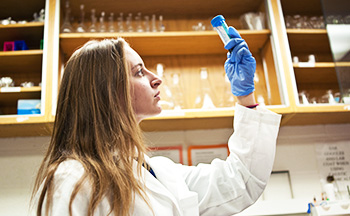
The forensic science major provides a solid foundation in the natural sciences and is applied through courses in biology, chemistry, and physics, complemented by rigorous focus on biological and chemical concepts and analytical thinking through coursework in biology, chemistry, computer science, engineering, mathematical sciences, physics, and statistics.
Students will also experience and receive training in multi-disciplinary approaches to forensic science; analyses applied to criminal and civil investigations; matters of administrative law; exploration of factors and events that influence individuals and groups to engage in criminal activity or commit acts of violence; and examination of issues that threaten national security and the tactics to counter such threats.
Loyola's forensic science program will develop and promote the skills needed for multiple career paths in the field of forensics, including excellent oral and written communication skills, intellectual curiosity, use of interdisciplinary approaches, critical and analytical thinking skills, and commitment to lifelong learning. Additionally, the forensic science curriculum emphasizes the development of strong moral and ethical character, essential traits for success and leadership in the field.
Curriculum
Required Courses
Forensic Science Core
- FO 101 - Introduction to Forensic Science w/ Lab
- FO 102 - Scientific Basis of Forensic Investigations
- FO 320 - Forensic Serology of Animal and Human Body Fluids or
- FO 322 - Forensic Ecological Evidence
Natural Science Core
- BL 150 - Foundations of Biology I and
- BL 151 - Foundations of Biology I Lab
- BL 152 - Foundations of Biology II and
- BL 153 - Foundations of Biology II Lab
- ST 110 - Introduction to Statistical Methods and Data Analysis or
- ST 210 - Introduction to Statistics
Social Science & Humanities Core
- PY 101 - Introductory Psychology
- PY 202 - Psychopathology
- SC 100 - Introduction to Sociology
- WR 325 - Professional Writing or
- WR 326 - Technical Writing
Forensic Science Capstone (choose 1)
- FO 481 - Cold Case Investigations
- FO 482 - Advanced Cold Case Investigation
- FO 494 - Forensic Science Research I
- FO 495 - Forensic Science Research II
- FO 497 - Forensic Science Internship
- FO 499 - Forensic Science Independent Study
Electives (choose 5)
Forensic Science
- FO 230 - Introduction to Criminalistics
- FO 284 - Forensic Chemistry
- FO 300 - Crime Scene Investigation
- FO 319 - Supporting Twenty-First Century Policing with Forensic Evidence
- FO 325 - DNA Analysis in Forensic Investigations
- FO 330 - Biological and Forensic Science Quality Assurance
- FO 336 - Forensic Toxicology
- FO 347 - Trace Evidence and Questioned Documents
- FO 350 - Foundations of Comparative Sciences
- FO 351 - Forensic Entomology with Lab
- FO 360 - Introduction to Investigative Genetic Genealogy
- FO 376 - Digital and Forensic Imaging
- FO 377 - Death Investigation
- FO 385 - Introduction to Firearms and Toolmarks Analysis
- FO 390 - Topics in Forensic Science
- FO 395 - Crime Scene and Evidence Photography
- FO 404 - Victimology and Applications to Violent Crimes
- FO 406 - Investigations of Violent Crimes
- FO 411 - Animal Law
- FO 415 - Forensic Anthropology
- FO 440 - Bloodstain Pattern Analysis and Crime Scene Reconstruction
- FO 450 - Forensic Cognitive Psychology
- FO 452 - Forensic Science Errors and Wrongful Convictions
- FO 481 - Cold Case Investigations
- FO 482 - Advanced Cold Case Investigation
Natural & Applied Sciences
- BL 281 - General Genetics
- BL 321 - Synthetic Biology
- BL 322 - Synthetic Biology with Lab
- BL 341 - Molecular Genetics with Lab
- BL 431 - Biochemistry I and
- BL 433 - Biochemistry Lab I
- BL 432 - Biochemistry II and
- BL 434 - Biochemistry Lab II
- CH 317 - Quantitative Chemical Analysis and
- CH 318 - Quantitative Chemical Analysis Lab
- CH 410 - Instrumental Methods and
- CH 411 - Instrumental Methods Lab
- CH 431 - Biochemistry I and
- CH 433 - Biochemistry Lab I
- CH 432 - Biochemistry II and
- CH 434 - Biochemistry Lab II
- CS 115 - Cyber Security and Digital Forensics
- CS 151 - Computer Science through Programming
- CS 212 - Object-Oriented Data Structures
- CS 312 - Object-Oriented Software Design
- EG 381 - Probability and Statistics
- IS 358 - Applied Machine Learning
- MA 251 - Calculus I
- MA 252 - Calculus II
- PH 383 - Physics of Medicine and the Human Body
- PH 384 - Waves and the Physics of Medicine
- ST 381 - Probability and Statistics
Social Sciences
- EC 220 - Business Statistics
- EC 420 - Econometrics
- EC 460 - Business and Government
- PS 322 - Mock Trial
- PS 337 - Analytical and Legal Reasoning
- PS 338 - Constitutional Law: Federalism and Separation of Powers
- PS 339 - Constitutional Law: Individual Liberties
- PY 253 - Multicultural Issues in Psychology
- PY 265 - Forensic Psychology
- SC 201 - Self and Society
- SC 207 - Social Problems
- SC 233 - Juvenile Delinquency
- SC 260 - Introduction to Criminal Justice
- SC 331 - Deviance and Social Control
- SC 332 - The Sociology of Crime and Criminals
- SC 347 - Special Topics in Criminology
- SC 360 - Critical Analysis of Criminal Justice Outcomes
- SC 371 - Sociology of Serial and Mass Murder
- SC 430 - Seminar: Gender and Justice
- SC 435 - Seminar: Forensic Sociology
Humanities
- HN 323 - Photographic Vision: Tools, Techniques, and Theories
- PT 301 - Photographic Vision: Tools, Techniques, and Theories
- HS 232 - Law, Lawyers, and Litigants in European History
- HS 258 - Volcanoes, Fire, and Flood: Disasters of Ancient Rome
- HS 382 - Crime and Punishment in Latin America
- HS 386 - History of the Police
- PL 235 - Philosophical Perspectives: Philosophy and Science
- PL 311 - Bioethics
- PL 315 - Ethics after Auschwitz
- PL 333 - Philosophy of Law
- PL 335 - Political Philosophy: Justice and Mass Incarceration
- PT 270 - Basic Digital Photography
- PT 361 - Digital Image
- TH 318 - Bioethics and Social Justice
Business
- AC 420 - Forensic Accounting
- LW 109 - Business, Law, and Society: Special Topics
Example of a Typical Program
Advising Considerations
- Students considering a career in forensic science are encouraged to seek an internship to fulfill the capstone requirement.
- At least one Forensic Science elective must be from a different academic division (i.e., Humanities, Social Sciences, Natural and Applied Sciences, and Business) than the other four.
- The level of statistics to complete is dependent on career aspirations.
- Students may count courses in the forensic science major and another major or minor, consistent with the double course counting policy of the university and/or academic program.
Other Options
The forensic science major is interdisciplinary and flexible in design. This combination lends itself to students electing a minor or even a double major with forensic science. Opportunities for double majors with forensic science include:
- Biology
- Biology/Chemistry
- Biology/Psychology
- Chemistry
- Computer Science
- Psychology
- Sociology
- Other majors
Contact Us
Undergraduate Admissionadmission@loyola.edu
410-617-5012
Catherine Newberry
Program Assistant
Department of Forensic Science
cnewberry@loyola.edu
410-617-2314