A Winning Team Bonded for Life
Loyola’s first-ever national soccer champions mark milestone anniversary this fall
In 1976, Nick Mangione, ’80, was barely into his college soccer career at Loyola when older teammates began to say they were on their way to a national title.
At first, he could scarcely believe them.
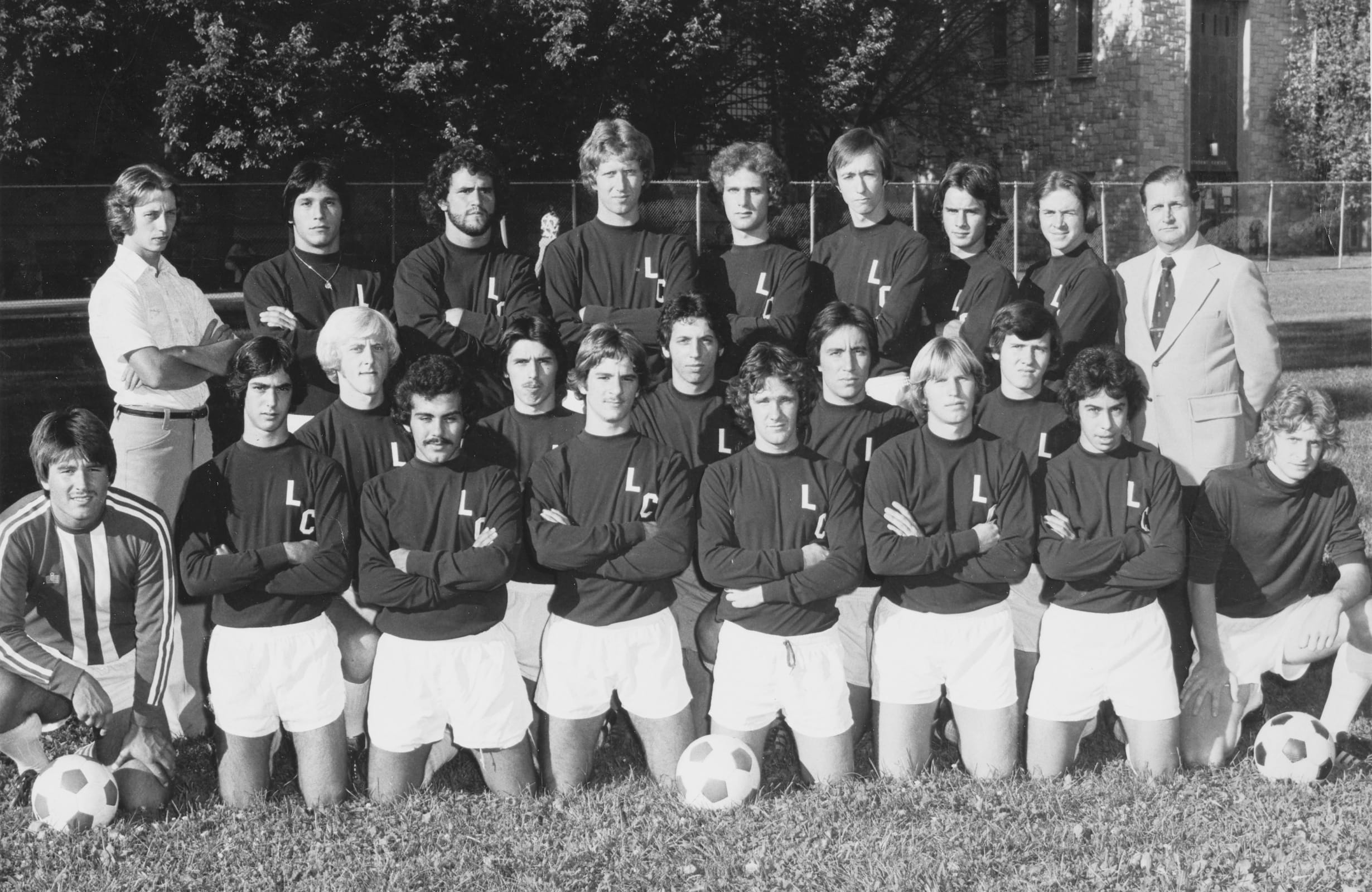 The 1976 soccer team won Loyola’s first-ever national title. They marked the 50th anniversary this fall.
“I used to think that was early to start that positive thinking,” Mangione said. “But they were right. I always knew Loyola had a great program. I used to watch them as a kid. When I got there, I didn’t know any better. I was a freshman. After that game against Adelphi, which was pretty early in the season, I knew there was something special.”
So did the rest of the Greyhounds, who went 21-1 on the way to the school’s first NCAA Division II championship and the forming of bonds that remain to this day. The team reunited on Loyola’s Evergreen campus Sept. 12 to celebrate the 50th anniversary of the title run.
While Loyola was strong all over the field, its defining strength was an offense that averaged 4.19 goals and scored multiple goals in all but one game, a 1-0 defeat of Rollins to seal a trip to the Division II semifinals.
“When you have Pete Notaro leading the nation with 31 goals, we’re bound to score,” said forward Mario Scilipoti, ’79. “Being a part of it was easy. Petey had the speed, Ian [Reid, ’78] had the skill, Nicky had the skill, and I just had a pretty good head ball. It was a good combination of offensive prowess.”
We knew every Saturday we’d have a big crowd, and we played to it, for sure.
It made for an appealing way for students to spend a weekend afternoon in the middle of campus. Chances were, Loyola would put on a memorable display—not to mention win. At games like the one against the University of Baltimore, students stood two to three deep watching.
“People were in the trees watching the games if they couldn’t get in,” Scilipoti said. “It was exciting. We knew every Saturday we’d have a big crowd, and we played to it, for sure.”
It was also a team deeply rooted in the community. All but one player on the roster graduated from high school inside Baltimore or within five miles of the city line. There were no out-of-state players, and while more than half the roster played high school ball at Calvert Hall College or Archbishop Curley High School, just about everyone was familiar with one another prior to college.
“We all played against each other when we were teenagers down at Patterson Park,” Mangione said. “It’s a credit to the coach, Jim Bullington, '52, to pull that group of guys together so we just all molded together in a positive way. We never had any kind of drama at all that season.”
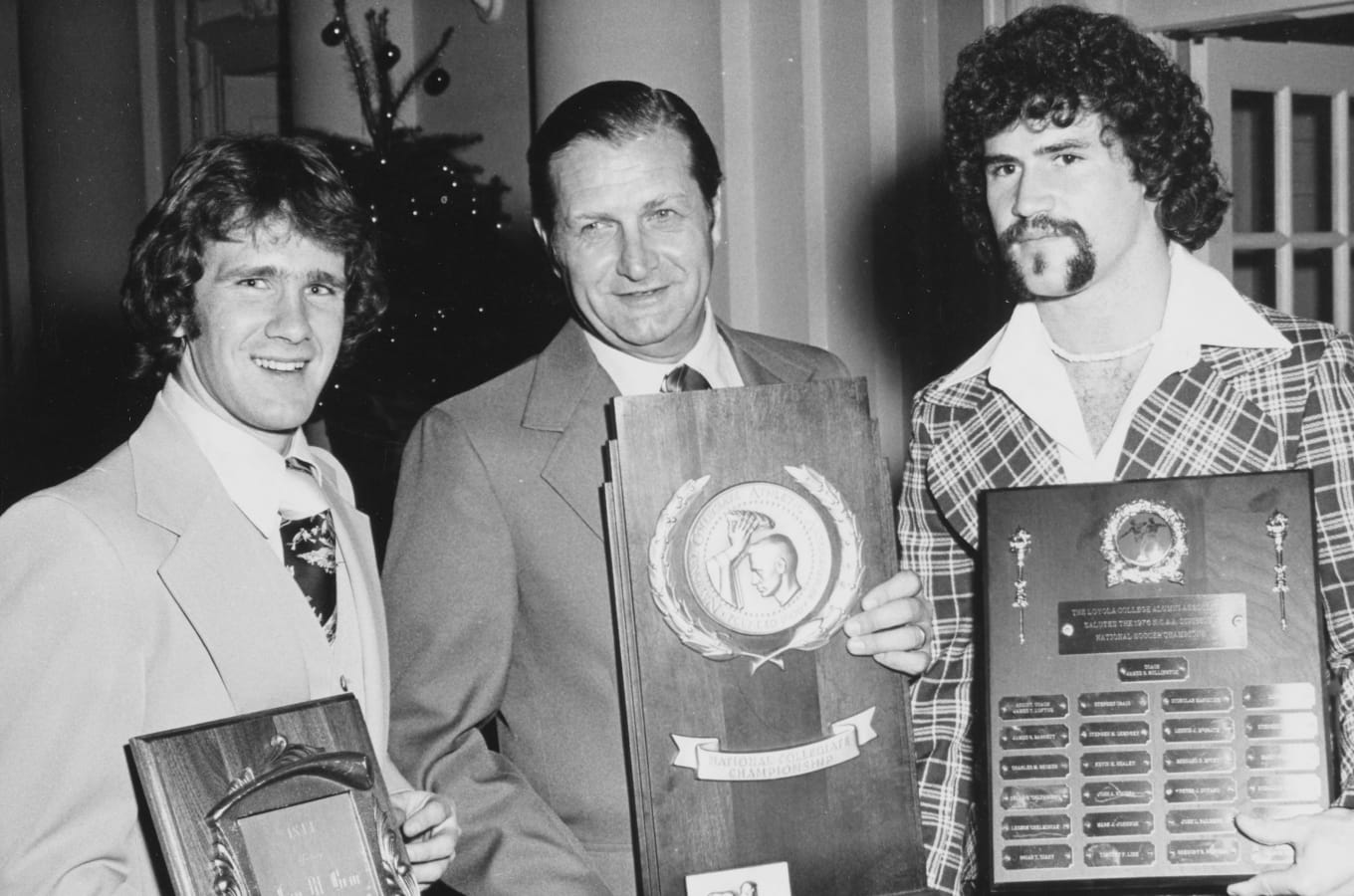
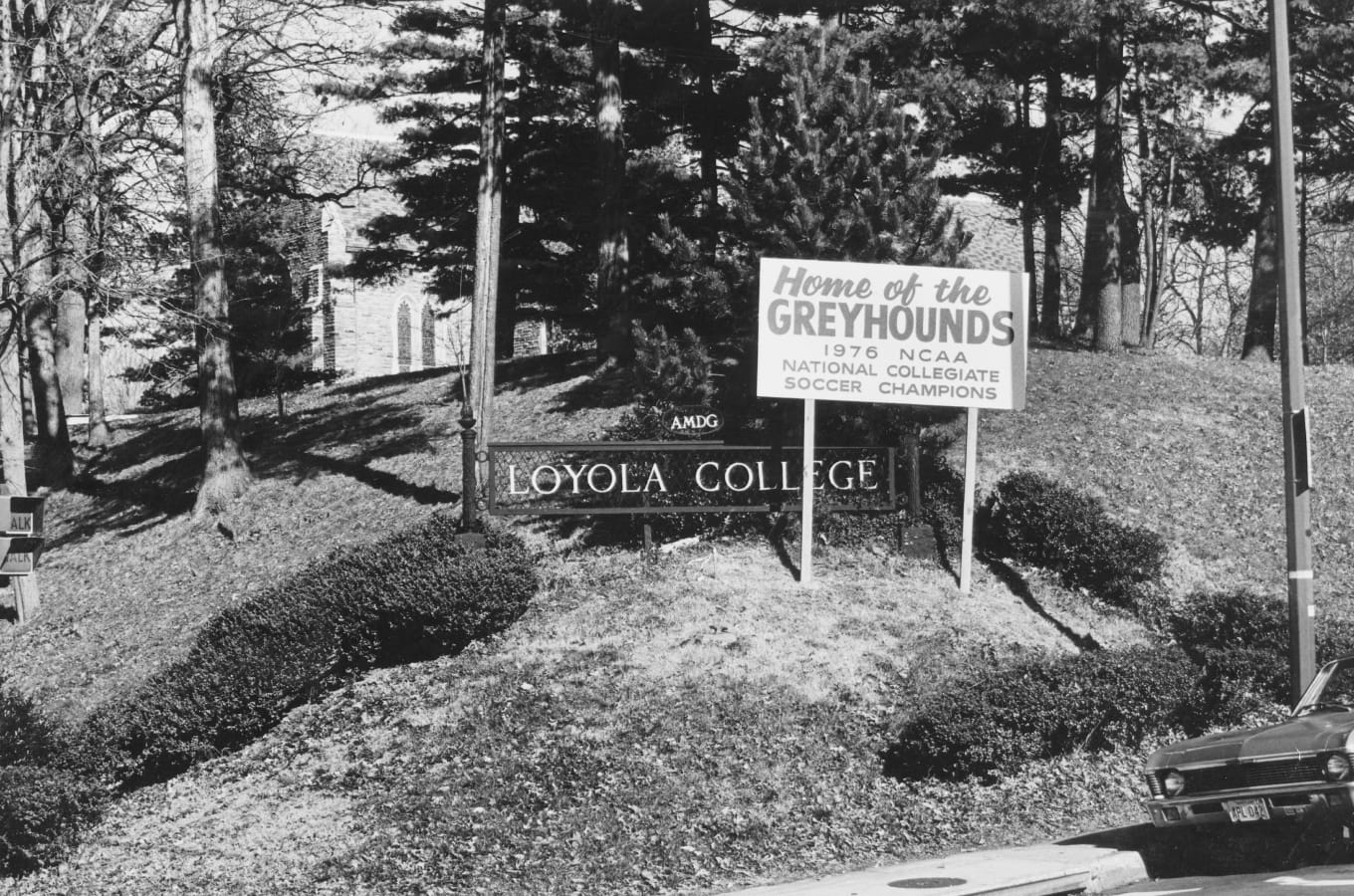 Photos courtesy of the Loyola/Notre Dame Library
Loyola traveled to NCAA championship host Seattle Pacific for a strength-vs.- strength matchup with Chico State, a California school with a defense dubbed the No Goal Patrol. The Greyhounds were unfazed, collecting a 3-2 victory to advance to the final two days later against New Haven.
“You were literally calling people because of the time difference late at night to say ‘Hey, we won our semifinal game,’” said fullback Steve Dempsey, ’79. “None of this, ‘They were up 1-0 at the half.’ Nobody knew anything. Even after it was over, you had to call your parents and tell them, ‘Hey, we won.’ [Local media legend] Vince Bagli, ’49, a 2003 member of the Loyola Athletics Hall of Fame, couldn’t even get it on the late-night news because we were on Pacific time.”
We knew we were going to win.
Mangione vividly recalls the team sharing a Thanksgiving meal during that championship weekend, and longtime Loyola administrator Rev. Daniel J. McGuire, S.J., offering a prayer at Mass. While the conditions weren’t favorable for the up-tempo Greyhounds—slick and cold on an artificial turf field—Loyola took 32 shots in a 2-0 victory to claim the title. Reid was named the tournament’s most outstanding offensive player, while John Palmere, ’79, took top defensive honors.
“Going into New Haven, there was no way we were going to lose that game,” Scilipoti said. “We knew we were going to win.”
And with that, a team filled with guys who commuted to campus each day put the Greyhounds on the championship map.
Winning Loyola’s first national title in any sport remains a distinct point of pride for a group that remains tied together a half-century later. They have an email list, and Dempsey said the text group they are all part of was especially vibrant during this summer’s World Cup.
The team was first honored when they were inducted into Loyola’s Hall of Fame in 2016. This time, they remembered Bullington (who died in 2001) and ace goalkeeper John Houska, ’78, (who died in 2020) and celebrated the achievement that made them a forever team.
“It’s something that kind of changed our lives and probably formed our future nearly 50 years ago,” Mangione said. “We’re very, very blessed to be able to be together.”